Well report No. RR-3881 · T5N · R23W · SEC 29 · filed October 15, 2026
Refining & PetrochemicalsWell report
Fire Reported at Ryazan Refinery After Drone Strike
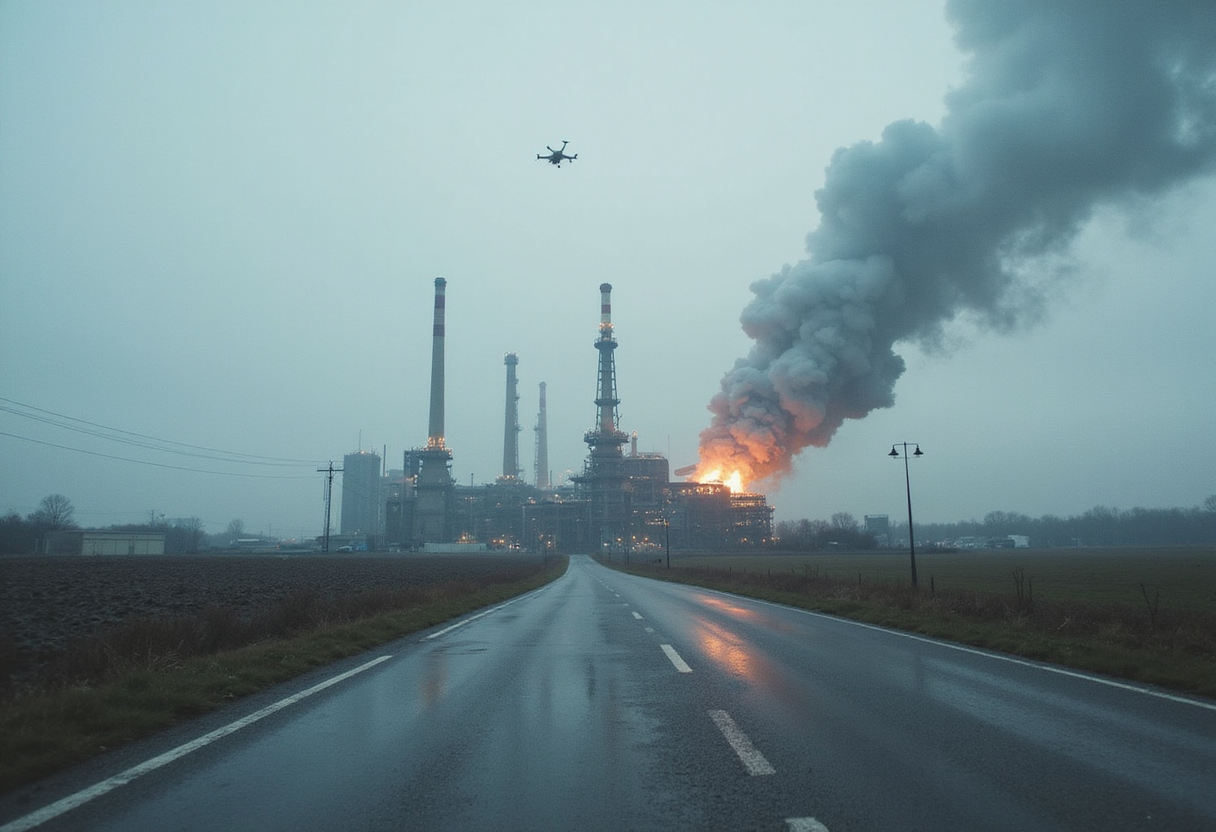
Fire broke at Russia's Ryazan oil refinery after a drone attack, officials said, hitting one of the country's largest fuel production sites.
Field notes
- Fire reported at Ryazan oil refinery after drone attack, per Russian officials
- Ryazan is one of Russia's largest refineries, supplying Moscow region fuels markets
- No damage assessment or unit-level confirmation published yet
- Strike fits sustained campaign of drone attacks on Russian refining assets
- Watch item: possible fuel export restrictions or run-rate update from operator
By James Calloway
Fire broke out at the Ryazan oil refinery after a drone attack on the plant, Russian authorities reported, marking the latest strike on one of the country's major fuels production sites.
The Ryazan refinery, southeast of Moscow, ranks among Russia's largest refining complexes and is a key supplier of gasoline and diesel to the domestic market. News of the fire was carried by Ukrainian outlet Pravda, citing Russian reporting on the incident.
For refiners and fuel traders, the immediate question is run rate: any sustained outage at a plant of Ryazan's scale tightens distillate and gasoline supply in Russia's central district and pushes more barrels toward emergency import channels or export curbs. Russian officials have repeatedly used export restrictions and producer gasoline sales on the exchange to stabilize domestic fuel markets after previous refinery strikes.
What does the strike change?
Drone attacks on Russian refining assets have accumulated through 2024 and into 2025, hitting plants from the Baltic to the Volga-Okta corridor. Each incident adds unplanned downtime at sites that were built to run around the clock.
The pattern matters to operators for three reasons:
- Repair timelines for damaged crude units or hydrotreaters typically run weeks to months, not days, depending on whether primary distillation took the hit.
- Cumulative outages shift domestic product balances and raise the odds of export bans or allocation mechanisms.
- Insurance, staffing and turnaround scheduling around damaged sites become moving targets for traders and logistics planners.
Russian authorities have not yet published a damage assessment for the Ryazan site, so any estimate of lost throughput remains speculation until the operator or officials confirm which units were affected.
How does this fit the wider campaign?
Ukraine has systematically targeted Russian refining capacity, and Ryazan has been struck before. The repeat attacks suggest a deliberate strategy of degrading fuel production capacity rather than one-off disruption.
For downstream watchers, the practical measure is aggregate offline capacity: analysts tracking the sector have estimated that successive strikes have temporarily removed a meaningful share of Russian refining throughput at various points, though Moscow has managed to restore most runs between waves of attacks. Treat any single-figure estimate as analysis to attribute, not settled fact — independent verification of run rates at struck plants remains limited.
The Ryazan fire also lands in a tight product market. Russian gasoline and diesel inventories swing seasonally, and the spring maintenance window leaves less slack for absorbing a major plant outage. A prolonged disruption would test the government's toolkit of export restrictions once again.
What to watch
The watch items are straightforward: an official statement on which process units caught fire, a run-rate update from the plant's operator, and any move by Moscow on fuel export quotas or exchange sales in the coming days.
For now, the number that moves this story — Ryazan's lost barrels per day — is exactly the number nobody has confirmed.
via Google News: Refineries and petrochemicals (Source)
More from James Calloway
Show full bio
Staff writer covering people, launches and day-to-day practice in Oil and gas industry operations and markets at Rig & Refinery.
504 articles