Well report No. RR-6561 · T15N · R42W · SEC 3 · filed October 14, 2026
Refining & PetrochemicalsWell report
Sasol Secunda petrochemicals face 'serious challenges' in new analysis
Sasol's Secunda complex in South Africa, producing roughly 150,000 bpd of synthetic fuels, faces "serious challenges" per a new Conversation analysis that raises viability questions across the integrated coal-to-chemicals site.
Field notes
- Sasol Secunda complex produces roughly 150,000 barrels per day of synthetic fuels
- South Africa's Carbon Tax Act took effect in June 2019 and is now in its second phase
- Secunda ranks among the largest integrated coal-to-chemicals complexes outside China
- The Conversation article headline flags 'serious challenges' at Sasol's petrochemical operations
- Independent databases list Secunda as a top-tier single-point industrial emitter with CO₂ output in the tens of millions of tonnes annually
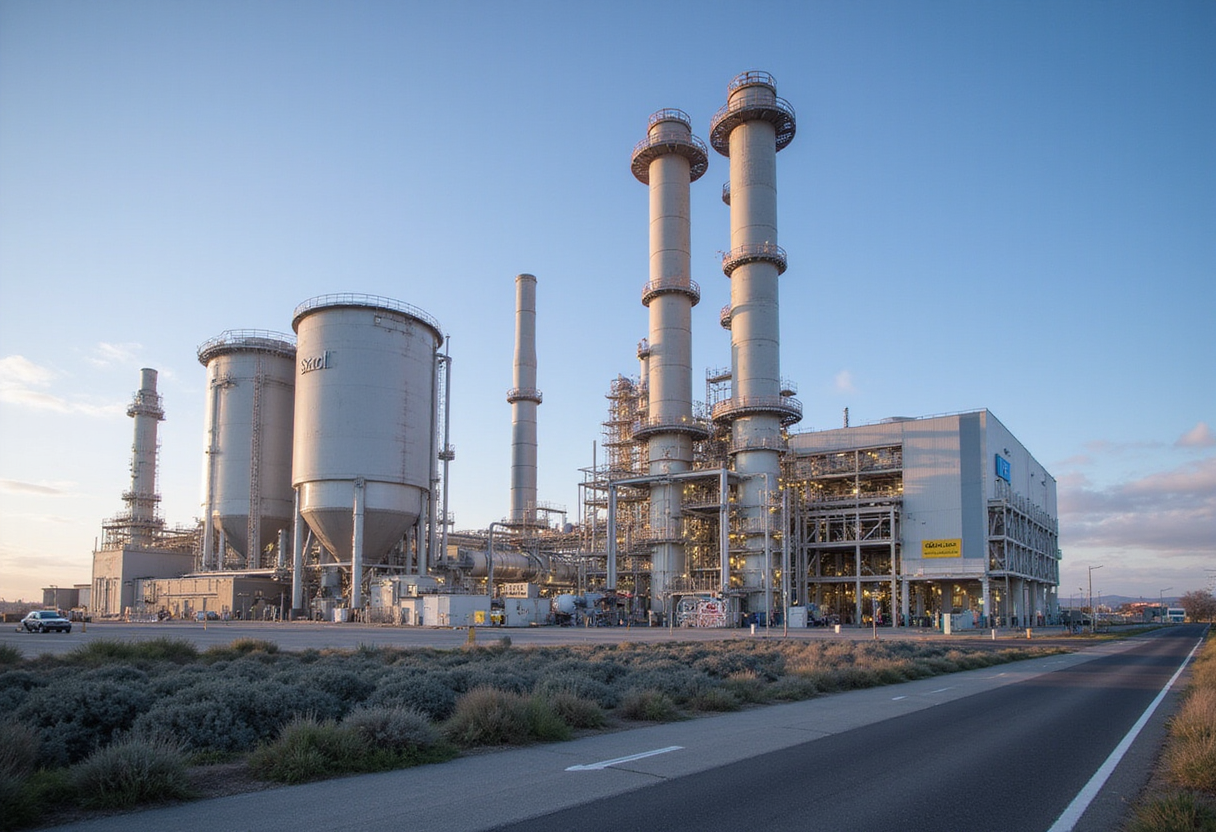
Sasol's Secunda complex in South Africa produces roughly 150,000 barrels per day of synthetic fuels (refined products made from coal-derived synthesis gas rather than crude oil), an operation now described as facing "serious challenges" in a new analysis from The Conversation.
The article, headlined "South Africa's massive Sasol petrochemical plant faces serious challenges – new report," catalogues mounting operational and structural concerns at the integrated coal-to-liquids (CTL) and chemicals site in Mpumalanga province. The piece, attributed to academic contributors, raises fresh questions over the long-term viability of Sasol's petrochemical footprint.
The headline framing of "serious challenges" implies structural rather than cyclical pressure on the integrated complex.
What does the Conversation report address?
The publication's commentary targets Sasol's petrochemical operations rather than the CTL fuels trains alone. Coverage spans economics, regulation and feedstock substitution. The Conversation typically commissions university-based experts for its Africa energy and policy coverage.
The piece lands during a sensitive period for Secunda's downstream assets. Sasol management has signalled capital discipline across its chemicals business in recent quarterly updates, with periodic commentary on margin compression and gas-versus-coal feedstock economics.
Author commentary frames Secunda as a stressed asset class rather than a routine maintenance story.
Where does Secunda sit in the global ranking?
The Secunda site ranks among the largest integrated coal-to-chemicals facilities outside China. Industry trackers consistently place its CTL capacity in the top tier globally, alongside Shenhua's Ningxia complex and select Indian CTL units. The site's petrochemical trains produce propylene, alpha-olefins, acrylates, ammonia and a range of solvents at scale.
Secunda also carries a heavy emissions profile. Independent greenhouse-gas databases classify the site as a top-tier single-point industrial emitter worldwide, with annual CO₂ output in the tens of millions of tonnes.
The site's emissions intensity sits at the centre of any long-term viability question.
What is driving the concern?
South Africa's Carbon Tax Act, in force since June 2019 and currently in its second phase, raises direct compliance costs on Secunda's CTL operations. Treasury has signalled further tightening through phase-three allowances under consultation. Industry analysts have previously flagged the complex as the country's most carbon-intensive single exposure to the levy.
Global petrochemical markets add pressure. New gas-based steam crackers (high-temperature furnaces that break longer hydrocarbons into light olefins) in the United States and Middle East supply propylene and ethylene at cost positions below Secunda's coal-derived output. Spot margins for South African polyethylene (a thermoplastic used in packaging and pipe) have lagged benchmark Asian and US Gulf Coast values for several quarters.
Compliance costs and global cracker economics form the dual pressure point on Secunda's chemicals trains.
What has Sasol management signalled?
Sasol's recent reporting cycle referenced optimisation across the chemicals business. Quarterly updates have flagged lower realised prices in ammonia and polymers. The company has cited cost-reduction programmes at its Lake Charles, Louisiana operations that analysts view as a parallel benchmark for any Secunda rationalisation.
Sasol has not announced a Secunda petrochemical mothball or conversion in its public guidance to date. Industry channels continue to watch for any heat-and-power rebalancing at the site that would alter its integrated chemicals economics.
Management language has shifted toward optimisation rather than expansion at Secunda.
Watch items
- Any Sasol disclosure on Secunda petrochemical unit turnaround timing or partial closure
- South African Treasury updates on Carbon Tax Act phase-three allowance design
- Quarterly Sasol Chemicals segment operating margin and utilisation disclosure
- Gas-versus-coal feedstock spread at South African gateway prices
The Conversation article does not name its academic contributor in the published headline. The publication typically commissions commentary from policy researchers across African universities. Trade-press coverage will monitor for additional author attribution and Sasol management response.
via Google News: Refineries and petrochemicals (Source)
More from Olivia Hart
Show full bio
Correspondent covering technology and product news in Oil and gas industry operations and markets at Rig & Refinery.
457 articles
Adjoining reports
- South Africa requires urgent refining investment, CEF chair says
- AEW 2026 to Put Carbon Capture on Africa's Oil and Gas Agenda
- C&EN signals end of North American petrochemical build cycle
- Oil and Gas Producers Rank Among Leading CCUS Adopters
- Technip Energies Takes FEED Work on Petkim Petrochemical Complex